Free Web Submission

Showing posts with label Dolphin Facts. Show all posts

Thursday, 17 April 2014

A couple of little known facts about dolphins

Because we all love to learn and want to know more about our friends of the sea here are a couple of little known facts about dolphins.   I hope you appreciate them as much as I do.   Please be sure to like us on Facebook and twitter.  You may also wish to check us out on pintrest as well as instagram.   We are here to serve so please check us out.   Also be sure to leave us comments or questions.


 A dolphin’s forelimbs which are known as ‘pectoral flippers’. The forelimbs or ‘arms’ of a dolphin are the same anatomically as a terrestrial mammals legs. But the bones which make up the forelimbs in dolphins have been shortened and made more rigid by supporting connective tissue. These pectoral flippers allow the dolphins regulate their speed and turn.

Not all dolphin species possess a dorsal fin. The dorsal fin of a dolphin, which is located on the back, acts like a keel when the animal swims. This gives the dolphin directional control and stability within the water column. Northern rightwhale dolphins and the southern rightwhale dolphins however lack dorsal fins.

Monday, 14 April 2014

Care for some milk?

One of the things I get to do is ask a lot of questions.  Today I asked how does a Dolphin nurse her young.   The answer might surprise you.

After a baby is born it must go to the surface of the water to take its first breath.   The mother or midwife (yes midwife) pushes the baby to the surface and it is able to get its first breath.   Newborn dolphins nurse at the surface and the young dolphin nurses while the mother floats on her side so that the baby can breath while nursing.   It is not till it is older that the baby can suckle underwater.   The mammary glands are in paired slits on either side of the reproductive opening.   The mothers muscles push the milk through the nipples into the mouth of the young dolphin.   

Thursday, 10 April 2014

Not by the hair of my chinny chin chin.

Did you know that Dolphins have hair?    Stop scratching your head and think about it for a second.   When a dolphin is born it is blind.   It requires help getting to the surface of the water for its first breath.  It needs assistance for everything.   This is where hair comes in.   The baby dolphin uses its hair to find where it should nurse from its mother.    Did you know that a dolphin nurses for nearly two years?... Interesting don't you think.

baby dolphin with hair. 

Wednesday, 9 April 2014

why do dolphins have teeth

I was asked the other day at Dolphin Cove  Jamaica's number one attraction. Why do dolphins have teeth.   The answer is quite simple.   They use their teeth to help catch food.   They do not use them like you or me.  They swallow their food whole.    I guess what I am saying is that their teeth are used like a tool or maybe like we use our hands.   To get their food and to eat but not chew.   Interesting don't you think?

Dolphin Cove Jamaica


Wednesday, 4 December 2013

What do the Dolphins at Dolphin Cove eat?

I seem to get this question a lot.   I will answer it here and of course I will answer it again.  Dolphins are marine mammals and as a result they eat fish.  They also eat other things such as shrimp, crab and squid.   They are also given vitamins on a daily basis.  Since Dolphin Cove Jamaica is a natural lagoon they have the opportunity to fish / hunt for food on their own.   I have witnessed these beautiful creatures work together to catch fish.  They do it in many ways.  The most exciting I have seen is when the Dolphins stun their prey with their tails.   This just goes to show how smart and creative these beautiful animals are.  
Dolphin Cove Jamaica, Dolphin Trek
Dolphin Trek available only at Dolphin Cove Jamaica.

Wednesday, 20 November 2013

Interesting write up about dolphins I found online.


Humans cherish and admire beings who possess noble traits. The resourcefulness, confidence and grace of dolphins endear them to our hearts and minds. It is because we search for the same characteristics in ourselves that we cherish these magnificent animals.
We like to think that dolphins enjoy being around us as much as we do them. Is it possible that dolphins share our company simply for diversity? Some species can become bored with their own kind. Who gets more out of the relationship: the human or dolphin? They provide us with insight into the realms of anatomy, behavior and communication. Still, our curiosity pushes us to learn more. Although we admire other animals, dolphins remain high on our list of species that fascinate us.
Scientists believe that marine mammals are descendants of animals that once lived on land. The skeleton of a dolphin supports this theory. There is a modified form of hands in the front flippers of a dolphin. Two small, unattached bones located behind the rib cage are believed to be remains of the pelvic girdle, to which hind limbs once attached. Most people wouldn’t know it, but dolphins have a common ancestor with hoofed animals, specifically cows. With so many cow lovers out there as well, it wouldn’t be a surprise. 

Tuesday, 29 October 2013

Dolphin Therapy fact or fiction

I read a lot of articles about Dolphin therapy and I wonder to myself is it fact or fiction.   The answer is I don't know.  I do believe that animals of all types benefit humans to a far greater extent than we can ever know.   I think about how many times I just reach out and pet the dog for no other reason than I want to.  How I look forward to my dog greeting me when I get home from work.  I think about how I feel when she is not well or has hurt herself.   I know that I feel better with her around.  I also know that when I work with and interact with the dolphins I also feel a sense of pleasure and relief.  I feel some of my stresses going away and a sense of calmness.  I guess it is considered a sense of therapy however I am unsure if it has a lasting effect.   I also take into account why little children and pregnant women should not interact with the Dolphins.  I know that the dolphin senses when they are near and their instincts take over and want to interact with them.   I can assure you that this is not in a bad way but the risks are too great.    So is Dolphin therapy real?  I am not sure.   But I do know that anything that makes you feel this great can't be bad for you.   Here is a link to a very good article that I have found.  You can decide for yourself.  Comments?  

Monday, 30 September 2013

Eating dolphins (not eating a dolphin)

One of the most frequent questions we are asked is how much does a dolphin eat.  There are many answers to this but most of them are silly.  I will stick to facts.   Dolphins eat a lot.  The amount of food they eat is in direct correlation as to what they are eating.  

Bottlenose dolphins eat several kinds of fish (including mullet, mackerel, herring, cod) and squid. The composition of the diet depends very much on what is available in the area they live in and also on the season. The amount of fish they eat depends on the fish species they are feeding on: mackerel and herring have a very high fat content and consequently have a high caloric value, whereas squid has a very low caloric value, so to get the same energy intake (calories) they will need to eat much more if they feed on squid than if they feed on mackerel or herring. On average an adult dolphin will eat 4-9% of its body weight in fish, so a 250 kg (550 lb) dolphin will eat 10-22.5 kg (22-50 lb) fish per day.

Tuesday, 17 September 2013

Views from My Desk

Here I sit.  Nearly four pm,  I look out the window of my office and see the happy faces of customers playing in the water with the sharks, Dolphins,  and stingrays.  I see a family eating Ice Cream and yet another couple having a nice cold Red Stripe.   I must say that I have a great view that only serves to tease me about the fun I could be having.   I could continue to write this post about the adventures that could be had at Dolphin Cove Jamaica however I would rather go outside and chat with a Pirate, while waiting for a kiss from a dolphin.   Why don't you Join me.

Monday, 9 September 2013

DR, Dr, Dr, I need a Nurse!!!

Are you aware that we have nurse sharks in Jamaica?   We do, but never fear they keep to themselves most of the time.  They prefer to be in their own little world and keep to themselves.  They are not man eaters they prefer to eat crustaceans as well as molusks.   Though they do have teeth they are not prone to biting.

At Dolphin Cove Jamaica LTD we too have nurse sharks.  They are at our Ocho Rios location and are considered by many one of our most exciting attractions.   Each day you will see our well trained handlers put on a bit of a show and you can have the chance to feed and interact with them.   For the adventurous spirit you will have a tremendous opportunity well worth the trip to Jamaica just to see.   Why not come and give one a cuddle?   For those of you looking to learn a bit more please check out this page.  http://schools-wikipedia.org/wp/n/Nurse_sharks.htm  For those of you interested in seeing one for yourself please check us out www.dolphincoveja.com


Friday, 6 September 2013

Dolphin vs Human how alike are we.


I have to admit that I borrowed this from the wiki.  The other day I was watching TV and I saw the mermaid documentary on the Discovery Channel.  It got me thinking about how they say that humans evolved from the sea.   Then I thought about dolphins (as one does when you work here)  I wondered what we all share in common.  This is what I found.  I felt that it was important enough to share with you.     Dolphins and humans more alike than you think.  

Both are mammals, so both have mammary glands, and hair on their skin, and they have 7 cervical vertebrae as humans do. 

They are touted to be one of the only 3 animals that mate for pleasure (humans, dolphins, bonobos), and socially with many partners as many humans do. They also mate face to face unlike other animals. Dolphins do give birth to live young, and as mammals, they nurse their young with breast milk. 

They have very high communication skills amongst themselves. They are very social and prefer to live in pods rather than alone. Females will create a communal/ family creche for the young, so that others may go to hunt and feed. They show emotions of happines and sadness. They mourn the death of a member of the pod, especially an offspring. They also display working in teams to achieve a common goal. When hunting, they create tight balls of sardines by circling and herding them, and then diving straight through them to feed. Pods are very protective of each other and sometimes show compassion, and may adopt a young out of another pod if it has been left behind or lost its mother. 

Additionally, they have mirror neurons, being able to pass the mirror test and detect themselves in a mirror. Mirror neurons may also indicate empathy. 

In short, they display more "human" emotions and behaviors than any other non-primate mammal.  Here is what I have found may be what the human dolphin combo may look like.

Thursday, 5 September 2013

Lets walk with the dolphins


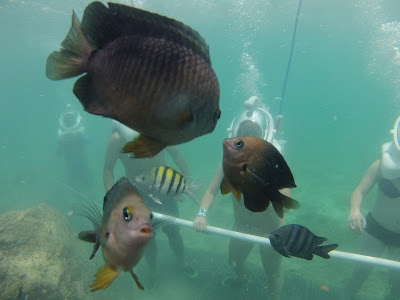
We at Dolphin Cove (Ocho Rios location only) offer a very special opportunity for you.  We have the Dolphin Trek experience.   


Dolphin Trek, with Sea Trek helmet, is the ultimate sea trek program where participants can walk underwater while surrounded by dolphins.  Dolphin Trek offers the most innovative intimate dolphin encounter on the planet!  Dolphin Trek is all dolphins, all the time.You participate in a brief presentation after which, you descend 12 feet under water to begin your interaction with these amazing creatures
Let me describe this for you in a bit of detail.  You don this cool looking helmet and walk under water while you interact with our dolphins.  Better yet.  Take a look at this video and see for yourself.  Jamaica Gleaner video with Dolphin Trek
I know that there is a lot of interest in people trying or learning to scuba dive so maybe take two things off your bucket list and try a Dolphin Trek.  You can walk with the dolphins and have a experience quite similar to scuba diving but with a lot less gear and danger.   

Wednesday, 4 September 2013

Some facts about our Dolphins.


In todays post I have compiled some dolphin facts. With back to school near we need to start to get our brains back into gear. Today lets learn about the care of our dolphins


Did you Know


Did you know
  • Dolphin cove has an internationally recognized animal care program?
  • Each dolphin participates in husbandry behaviours each day?
  • The health of every dolphin is closely monitored by a team of veterinarians?
  • All the dolphins at Dolphin Cove were either born here or come from Oceanariums in Mexico or Cuba?
  • All our dolphins have CITES permits?
  • Dolphin Cove has a very successful rescue and reproduction program


Members of this species adapt to and do well in the captive environment. They live long and healthy lives (on average, longer than in the wild) and have a high reproduction rate. They are playful animals, exhibiting a natural curiosity. Strong bonds are formed with their human counterparts. There is much that goes on in the life of the dolphin that we will never see or that is difficult to see in the wild. A controversial topic is holding dolphins in captivity. A recent Harris poll has shown that over 95% of the people polled feel that properly maintained and run marine mammal parks provide a heightened appreciation for and understanding of these animals and add to the efforts in their conservation as a species. With 126 million visitors to dolphin habitats each year, the opportunity to teach appreciation for and conservation of the dolphin is tremendous.

A study of Atlantic Bottle nose Dolphin life span in the wild carried out by the Alliance of Marine Mammal Parks and Aquariums has shown that there is 30% mortality in their first 12 months due to maternal abandonment, pollution, predation, boat strikes, entanglement in fishing equipment, capture for human consumption, and disease. In the wild, the average life span of the Bottle-nose one year or older is an average of 25 years. In captivity, Bottle nose dolphins live an average of 30-35 years, having veterinary care, non-polluted water, no predation, no boat strikes, quality controlled food, no fishing equipment in which to become entangled, and careful observation and support of the birthing and mothering processes. In a survey taken in 1983, 32% of all dolphins being held in captivity had been born at a captive habitat.